
Each boat has its own timing and speed in each dimension. Learning it and responding to it will help you to progress.
Once again, a lot of this relates to flat water, since I’m not exactly a demon freestyler in a hole or on a wave, with face surfing being one of my signature moves. But anyway, let’s look at boat timing, because it’s important when it comes to learning moves like the double pump, and hence bow stall, as well as cartwheels and other moves.
I’ve gone into this a little bit in my article about tips for the double pump, but it’s worth emphasising again, because learning how to take advantage of the timing of your boat will be the difference between achieving a bow stall or cartwheel, or not. So, what do I mean by boat timing?
When you perform the first part of a double pump you are lifting the boat’s bow into the air while holding the kayak on edge. Except, are you really lifting the bow into the air? Well, you are, but something else is happening behind you. The stern is being sunk into the water. Different boat designs with different volumes, volume distributions and degrees of sliceyness will all behave differently. What helps you get the bow down is that when the stern is sunk into the water the buoyancy means it will get rejected. Performing a successful double-pump is all about maximising the energy that this rejection gives you.
A vast number of people fail the double pump because they aren’t sinking the stern enough into the water during the first phase. In addition, the same people will often try to initiate the second half of the double pump to try and get the bow down in a rush before the stern has begun maximum rejection speed.
I see it all the time, with the first stroke being cut short and the bow simply not being lifted out of the water anywhere near enough. This is a particularly important factor if you are on the light side for your boat or learning the move. If you’re heavy in your boat, you can get away with poor technique, which will set you up for bad habits later on. So it’s as well to get into good habits from the beginning.
This is why you should be ‘listening’ to your boat timing to feel and understand when that second double pump stroke and feet push should happen for maximum effect. Because I’m light in my RockStar V, I have to put maximum effort into lifting the bow/sinking the stern, and my timing for the second stroke is quite slow compared to my old Gui-Gui Helixir. Instead of the timing being bam-bam for the two strokes, it’s bam—–bam.
I need my paddle all the way back for the second stroke, too. No cutting it short. You should bring that paddle much further back towards the rear of the boat than you think necessary. I see a lot of paddlers only bringing it back towards the back third of the boat and then trying to use the back stroke to try and force the bow down. The further back you can bring it, the more you’ll emphasise your body rotation. But, I’m digressing here. The fact is that once you’re in tune with the timing of how your boat goes from the stern to the bow, you won’t even need that second stroke.
Now, I have a slightly ‘unorthodox’ double pump technique in that I do lift my arms up at the end of the first part of the movement. I do this (unconsciously) in the RockStar V because I really want to get the blade out of the water and slam down on the second half to get the bow down. However, I can still do the double pump in the boat without using the paddle for the second stroke if I want to. Why am I telling you this? Well, because I want to show you the screen grab below to show you just how exaggerated my movement is, and just how high the bow is out of the water.
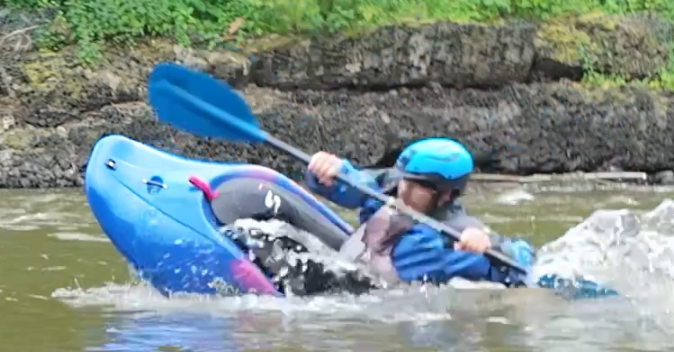

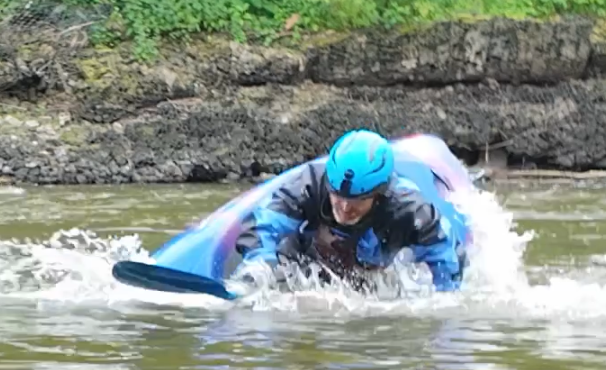
Now, as I said previously, you can get away with a lot in a smaller boat. Less exaggerated body movements, less effort with the paddle or no paddle at all. And, as you get better at it you’ll be able to gauge more how much effort and movement you need. This is why the top guys look like they are putting no effort at all into doing it! But, learning to go with the timing of your boat’s transition from stern to bow will always be one of, if not the most important factors in getting your kayak into a bow stall or cartwheel.
 The Kayaking Journal
Recent comments