
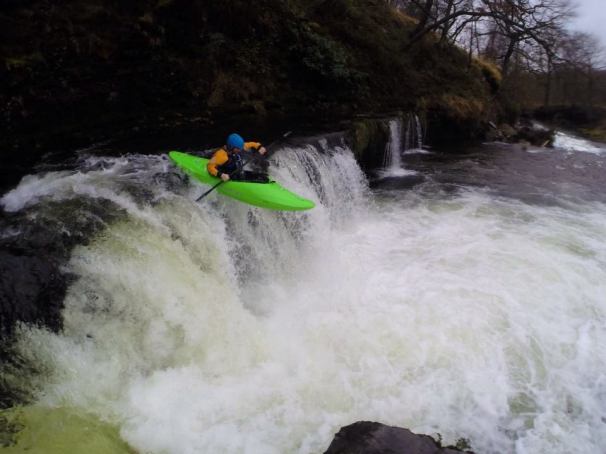
Not a perfect power stroke by any stretch, but notice I’m not leaning back, and the boat is going forward off the ledge rather than pitoning off the ledge.
The power stroke is everything. It helps you boof, it helps you go into and out of eddies. When timed to perfection it opens up a whole load of new confidence and ability. But a good power stroke is simply a perfect stroke with methods that apply to all strokes.
This blog post should really encompass all forward strokes, since a power stroke in its most basic form is the same as a normal forward stroke. The power stroke can be used as the basis for boofing, or as a powerful key stroke to get you into eddies, as well back into the flow in a controlled manner.
Paddle strokes are infinitely varied. Some are vertical for pure forward driving, while others are further out from the boat. While we are in white water our strokes go through all sorts of variations based upon feel and need at any given moment. So I shall focus this post upon generating power for a pure forward stroke.
I will not be going into the precise arm and hand positions and foot pressure, but I would like to concentrate on the main ‘engine’ of the stroke, and the method of using it, vs some other variations I have heard being taught. The proof is always in the pudding, so if you do find yourself disagreeing with me (assuming that you are following and understanding precisely what I am saying) please go out and try for yourself rather than dismissing things out of hand.
The engine
The ‘engine’ of your stroke is your trunk. In simple terms your body, via your arms, is what connects the boat to your paddle. Any inefficiency in this connection means that useful power from your blades is dissipated before it can deliver useful forward motion to your kayak. Just as a paddle shaft made from spaghetti would be useless, it is also useless to have a useful rigid paddle shaft and a body structure as flexible as spaghetti. In addition, when you perform a forward stroke, the main thing to remember is that the aim is that you are bringing the boat past the paddle blade, and not pulling the paddle through the water. #important.
Pelvic thrust?
There is a school of thought that one way of delivering a power stroke to, say, drive a kayak over an eddy line, is to ‘pelvic thrust’ as the stroke is taken. Some people do this motion when they are trying to paddle forward in a powerful way, too. Aside from a dance routine in a Full Monty tribute I’m not convinced of its usefulness.
There are a number of problems with thrusting forward like this. It is one of those techniques that ‘feels’ powerful, but when you examine the mechanics, is actually taking away more potential power and forward motion than it is giving. There is a parallel between this and people who do not know how to throw a punch effectively. They tense up their arms and fist, and it feels very powerful, but is in fact reducing its effectiveness drastically. Feeling like something is good is not necessarily the same as actually being good.
The same thing goes for the method whereby paddlers will pull the paddle through the water, leaning back as they do so, for their power stroke. This not only puts their body in an unstable position, but it also does not use the full power potential that the body offers.
The bounce?
Yet other methods put forward ‘bounce’ into the boat, bouncing the bow of the hull into the water. Once again this feels powerful, but is ineffective. By pushing the bow into the water you are literally just burying more of the boat into the river, creating drag, and therefore nullifying any momentum that you have created. It might be argued that the hull then gets rejected by the water, but in reality this is only a vertical rejection, not a forward one.
The way to be more efficient is to be quiet with the hull, rather than disquiet. Not to mention that the energy you are using to bounce the boat, could be better used by generating more power through trunk rotation.
Don’t believe me? Try it. Get some speed up and stop paddling. Measure the distance and see if the boat actually gains any more forward momentum by bouncing the bow up and down! I fear that all you will achieve is the consumption of more calories of energy. Which is great if you are on a diet, but not so great for getting your kayak to move forwards.
So we must understand the differences between ‘feeling’ powerful and actually being powerful in reality.
Thrusting the lower body forward with a pelvic thrust offers the following restrictions to effective power delivery:
- It disconnects the lower body (the part that is connected to the boat) from the upper body (which is holding the paddle).
- It curves the spine, which greatly restricts trunk rotation (if you don’t believe me, sit on the floor and do the thrusting motion while trying to rotate the trunk effectively).
- It turns the stroke into much more of a ‘pulling’ motion, which is only using half of your potential paddle stroke power delivery, not to mention placing much more strain on your back and arms than is neccesary.
As I mentioned earlier, your trunk is your engine. Your mid and upper body muscles are far more powerful than your arms alone. In the paddle stroke your ‘bottom’ arm’s function is to guide, not pull, the paddle on its intended line through the water.
Trunk rotation
It is solely your trunk rotation connected to your arms that should be making the paddle blade move from the front of the boat back towards your hip. Extra power can be added to the motion by, when the shoulder on your top arm side pushes/rotates forward, you should perform what could be termed a cross punch in boxing parlance. This is effective because the top arm movement is in addition to, and being helped by, your trunk motion, creating leverage with the paddle. It is stacked power in other words. Like having two steam locomotives pushing a train of carriages instead of one.
By keeping your spine straight, and body leant only ever so very slightly forward, feet braced against the footplate, and your abs slightly tensed, you can benefit from the full rotation of your trunk, and all of the power from your paddle will be translated down through your lower body into the forward motion of the boat.
But make no mistake, the paddle is never ‘pulled’ through the water. If you only remember one thing, it is that you are levering the hull past your paddle, not your paddle past your boat. In a perfect world, your waterborne paddle blade should remain in a relatively static position on the water as your boat hull goes past it. This is true for all strokes.
If the paddle blade is pulled through the water, this would be the kayak equivalent of spinning wheels in a car. This is noticeable with powerful paddlers, who, if they pull the blade through the water will create paddle ‘flutter’.
One last thing, in Dragon Boating one of the signs of a good stroke was how quiet it was. This applies to a kayak stroke as well. If you are creating splashes and spray with the paddle you aren’t being efficient.
As ever, I know people have their opinions on this and will disagree. But this is my interpretation.
 The Kayaking Journal
Recent comments