
Uganda is known as a paradise for kayaking, particularly freestyle. And it is all at risk from a new dam. Here’s our experiences of a life changing trip to the amazing country of Uganda
Africa has been one of those places that I have sought to go for as long as I can remember. My dad, now long since departed, moved to Kenya in 1947 and lived there for a number of years. Not exactly the best of times regarding British history, but none the less it was a place that really affected him. As a result as I grew up I was regaled by tales of the place, and the adventures that could be had there.
I still have many of the plate photographs he took of places like Victoria Falls and of places in other African countries. But I never actually thought that I would go there myself. Until I started doing more playboating.
Midway through 2017 my partner, Emily, really started getting the freestyle bug big time. When Lowri Davies of Flow Free Kayaking suggested Uganda as an awesome destination for us to go, who were we to refuse?! A new dam was being built and due to go online in May 2018, so this would pretty much be our last opportunity to visit the area and see the last of the best of what the White Nile has to offer. If we didn’t go now, then that would be that.

Preparations
Going to Africa, particularly with a kayak, is not a straightforward affair, especially if doing it for the first time. There are so many questions. The months leading up to the trip were passing by fast. There were airline tickets to be organised (along with the aforementioned kayaks), seemingly endless vaccination jabs, malaria medication (hint, don’t go cheap), travel gear etc. Unless you are already a seasoned world traveller the costs can soon add up. I have to say thanks to Dan Rea Dickens who offered a lot of encouragement and advice to me about the trip.
Undeterred we managed to get everything sorted in time. We decided to go hand luggage only, aside from our boats and paddles. We didn’t want to be faffing with suitcases etc when arriving late at night at Entebbe airport for our transport to our overnight stay at the Gately Inn. Although this did mean that I couldn’t fit my DSLR with telephoto lens into my bag. Something I would soon regret.
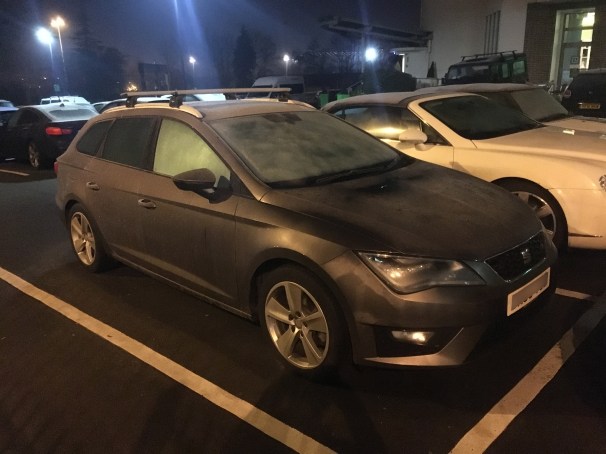
We wouldn’t be cold for much longer! Just about to leave the hotel carpark
We’re off!
The journey to Uganda isn’t the longest in the world at around 8 hours, but it is pretty tiring. We had set off at 4:30am from our hotel at Birmingham airport to get our car parked up and to get onto our first flight to Brussels. Even though we had pre-booked the kayaks, this being our first time taking boats on a plane doing this it was still stressful, wondering whether some jobsworth would take issue with them. The oversize luggage guys didn’t give us much confidence when they started muttering about boats amongst themselves. But happily everything went to plan.
We found that simply putting on a deck cover (so if anyone needed to inspect they could take it off easily) and then using a roof strap tied between the front and rear grab handles so the boats could be handled by ground crew easily did the job nicely.
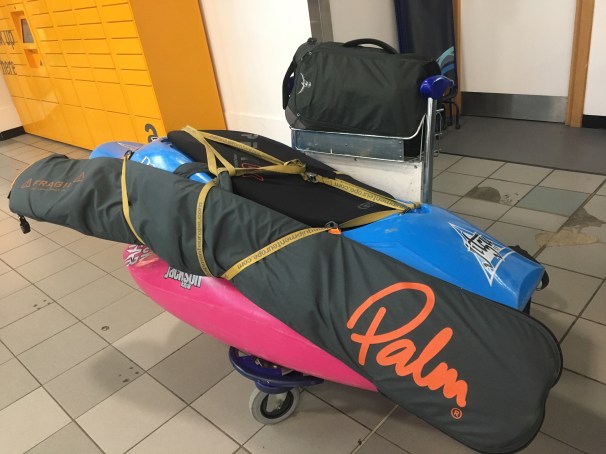
Look out! Chaos coming through!
Things then went pretty smoothly until our connecting flight at Brussels. My passport needed renewing in May, and even though I had checked previously about the 6 month rule and had already had my visa approved by the Ugandan immigration department, the serious looking man who lets people onto the aircraft was having none of it. Instead we got ushered to the sidelines while a few phone calls were made. Again, happily it got resolved, but we were wondering what on earth we were going to do if it was rejected! That would have been that I guess, and a dream squashed.
As it happens, it turns out that we were lucky. Many tourists have been refused boarding even though the country they are going to has already approved them and doesn’t require 6 months left on the passport.
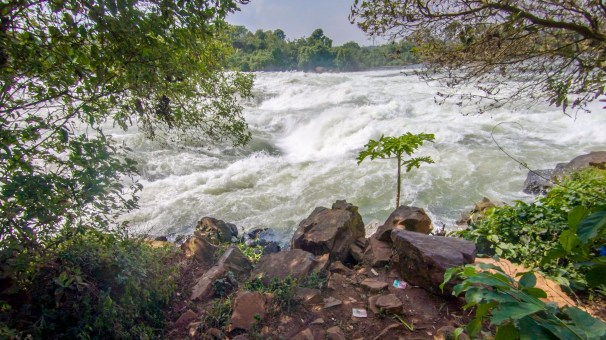
A glimpse of the incredibly huge and famous Itanda falls
Arrival in Uganda
10 hours or so later and we were finally at Entebbe airport standing like zombies in the immigration queue. Bed had never seemed so desirable. Finally we were through!
We were met by a man to transport us to our overnight stop over at The Gately Inn, a place that had been recommended to us previously. The driver lead us to the car park as we wobbled our boats along the rough pathways, taking out half the waiting public and many doorways in the process (as an aside, if you notice the terminal building at Birmingham Airport looking a bit wonky, I’m afraid I took out a few bits and pieces as I was carting my boat through the lobby, sorry!)
On arriving at our car we couldn’t help but notice that it had no roof rack. And it was a family saloon car. Our driver looked at our kayaks for a few seconds pondering the quandary and promptly hit upon the solution of how to transport our boats. He then proceeded to open up the boot and wedged my Jitsu in at a nice jaunty 45 degree angle, followed quickly by Em’s Rock Star and our paddles. Welcome to Uganda! I’m afraid tiredness didn’t allow my brain to process the idea of a photo op of this in action.
We then drove out of the airport towards our accommodation, where we were nearly taken off the road by someone driving on the opposite side of the road around a blind corner. Welcome to Uganda again!

The most welcoming beer in the world, ever.
We soon discovered that the number one rule of driving in Uganda is that you take the fastest and most efficient line as long as you avoid whatever is coming the opposite direction. The second rule of driving in Uganda is that you take the fastest and most efficient line even if you might not avoid what is coming the opposite way. Road markings here, where there is a road, are purely for decoration.
We managed to arrive at the Gately Inn intact. A man with a large gun opened the gate and let us in, whereby the nicest people in the world greeted us and got us settled into our room before having our first Nile Special beer of the trip. That was a glorious taste after all the travel, and I don’t think I’ve ever been so glad of such a drink.
As we wrestled with our mosquito net to get it all tucked in we made the very quick realisation that over here you really do get very close to the wildlife. Having the most gigantic ants I have yet seen running around the floor we tried to forget they were there and a very good nights sleep was had.

Amazing sunsets were par for the course in this view from the Explorers Bar
Off to Bujagali
We started the morning with the most amazing breakfast (“amazing” is a word you’ll be seeing a lot). Fruit like you just don’t get in the UK. As Em came out of our room it was as if the whole notion of fruit was new to us as she proclaimed “Bananas!”, spotting a banana tree right outside our door.
It wasn’t long before our driver for the week, Karim, arrived to take us to Bujagali. Karim is a wonderful chap and safely negotiated the madness of Kampala to deliver us to our final destination. The traffic here, particularly in the towns, is bonkers to say the least. Much of the time small motorbikes called Boda’s are used. They transport everything, and I mean everything. It isn’t unusual to see a whole family on one bike, or ridiculous things like full sized wardrobes being carried along.

If you’ve never been to this part of Africa before, it’s one of those places that wears its heart on its sleeves. This isn’t a place of polished tourism. Everything from the good to the bad is on show. It is refreshingly honest. Nowhere is this more apparent than when you hit the rural villages. But what strikes you is how friendly the people are. The children all wave and shout “Mzungu, how are you?!” Mzungu meaning ‘white person’. In western countries this term might seem derogatory, however, well, it isn’t. Despite the tourism in the area, white people are still very much a fascination here to the kids.
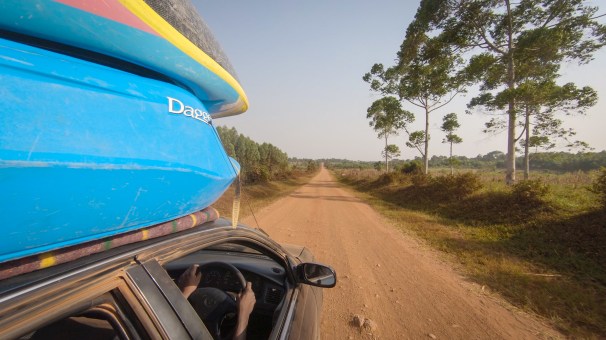
One of the many dirt roads travelled. Note that a cloth blanket is just as effective, and actually more convenient, than a roof rack!
Onto the river
We met with Lowri over a drink and some lunch at a place called the Black Lantern, which backs onto Nile River Explorers. Not realising we were going to be boating so soon, I had a beer… Schoolboy error!
Annnnyway, a short while later we found ourselves on the White Nile river for the first time! It’s vast. Those videos you see of it are usually just one channel of many across the whole width. The White Nile isn’t just wide. It’s WIIIIIIIDE!
To break us in we were taken on a section that contains some ‘grade 2’ rapids. I suppose on reflection they were grade 2, but, shall we say, rather bigger than the sort of thing you’d usually expect on a grade 2 in the UK!
However, it isn’t just the size of the river and its features that are impressive, and in some cases daunting, but the flat water, too, offers no let up. Think you can skirt the big stuff and get an easy ride going down the sides? No chance. If you think the eddies at CIWW or Nottingham are boily and do not represent a real river, then you need to visit Uganda to be corrected! Particularly on the larger rapids, the eddy lines on the White Nile are vicious.
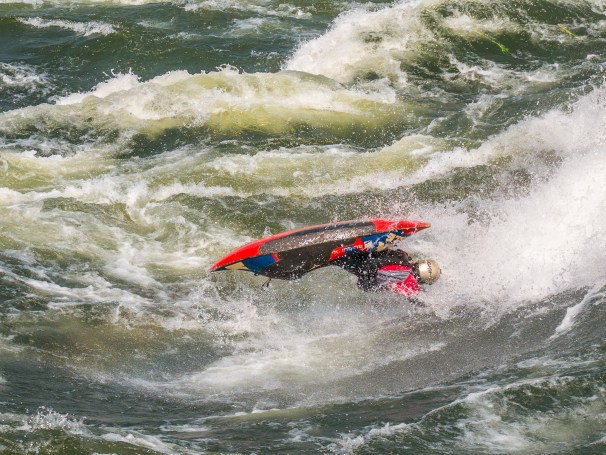
Craig Ayres takes flight during the Unleashed competition
Boils, surges, and whirlpools all appear out of nowhere to grab your edges, even on seemingly benign flat sections! It was apparent that this was going to be a learning experience. Effectively we were taken back to basics, breaking in and out of the flow. Something that I can do in my sleep on any UK river was now being reset to cope with the much large flows and huge eddy lines of the Nile. Such water would be a shock to the system in a large boat, but over here it’s all done in playboats.
Those nice ‘active’ paddle strokes you’ve been taught, nicely slicing the paddle back and forth in the water. You’ll be tripped up before you know it. Just getting across the eddy lines can be a mission.
This was something we learnt pretty quickly when we started to work on the Nile Special rapid. This was by far the biggest white water I’d dealt with.
We started working on the bottom section, which from the bank, and even in the eddies at water level looks deceptively small, especially compared to the waves at the top of it. The trouble is that looking at such water from the bank gives deceptive perspective distortion. And from water level from the distance you are from the wave train you are not seeing the depth of the wave troughs which disappear below the visual waterline.
Breaking into the flow across the eddy line, as I mentioned could be a mission. The actual eddy lines themselves are not like the UK where you go from the flat eddy across a nice defined line where the river starts to move downstream. Instead the eddy itself is majorly recirculating, and the the eddy line on its own could easily be wider than many UK white water rivers as a whole! Often with sea style waves coming at you along with the aforementioned huge boils, surges, and whirlpools!
Even once you think you’ve made it into the flow, a wave will come from nowhere at an odd angle, or the eddy line will actually change. So where once you were in the flow, now you’ve stopped dead fighting for balance in a big boily mess of water!
This can happen on the wave train itself, where a steep face presents itself and you either flip over backwards, or in some cases stopped and back surfed before it lets you go from the surging.

Emily surfing the Superhole wave
Superhole
Throughout the trip we spent a good deal of time at a place called Superhole. This is one of the areas most famous waves alongside Nile Special and Club. When it is running at the right levels pretty much every freestyle trick can be performed on it. It was a fantastic place to hang out.
Most times when you arrive at any of the get on’s for the river, you are greeted by kids who want to carry your boat for you. Don’t have any hangups on this. By paying them you help them and their families (it’s only 1000 Shillings, which is around 12p). The kids often get goes in the boats. Indeed on one occasion the local school kids got into our gear and out onto the water with Lowri, who showed them some rolling tricks to try.
Those kids put most UK paddlers to shame! We simply could not believe how long they would stay underwater for. They would go over and try and rolls, leaving the paddle by the side of the boat, try what seemed like 100 attempts, and then grabbed the paddle again before rolling up properly. I don’t believe that these kids breathe air. I’m convinced they have gills!

Emily stares in wonder at the size of the Itanda rapid! (No we didn’t run this one!)
It looks easy
It is very easy to watch videos of people paddling the Nile and be lulled into thinking that it’s easy, or that the big waves trains are simple to skirt or just bob down. Believe me, it isn’t as simple as it looks. Especially so as you are doing all this in a playboat, often carrying food in a dry bag, and plenty of water for hydration.
And we didn’t even do the biggest rapids. In fact I had a crisis of confidence part way through the trip. My roll, which I was pretty confident in previously, was failing me. Or rather I was failing myself. I found myself panicking and rushing the roll, resulting in failure, and yes, swimming. While the water is lovely and warm, and lots of people body board, with hundreds of raft customers going into the drink each day, I cannot say that I enjoyed swims on such water!
Those boils, surges and whirlpools? You lose buoyancy quickly and it is sometimes hard to get breath as you go through the crashing waves and then take more down time due to effectively being sucked under. I found it difficult to remain composed. Getting over my fear of water as a non-swimmer was one of the main reasons I took this sport up, and old demons I thought had long since been dispelled were coming back to haunt me.
But what we did do was enough. It is a shame that many of the other rapids I would like to go back and do will not likely be there any more after later this year, with the flooding of the dam possibly reaching as far as the bottom of Itanda. I guess we won’t know until the flooding is complete the full extent of the damage.
But our experiences of the rapids we did do, including Emily getting destroyed in one of the biggest holes I’ve seen on the left side of Real Deal (it sucked out much of her outfitting and airbags, and took her spraydeck from under her cag), showed us that we have a lot to learn when paddling this type of water. Confidence in the roll is a must, because on this sort of water it isn’t a matter of if you go over, it is when. And you will go over a lot, even if you are good. Not usually an issue for most who come here since they are usually freestylers.
Hairy Lemon
One of the many highlights of the trip was staying on the Hairy Lemon island. To say that this is a paradise would be an understatement. Pure bliss and tranquility (well until the Unleashed guys started singing football songs one evening, but we’ll let that slide). In fact words can’t even describe this place. You just have to see it for yourself.
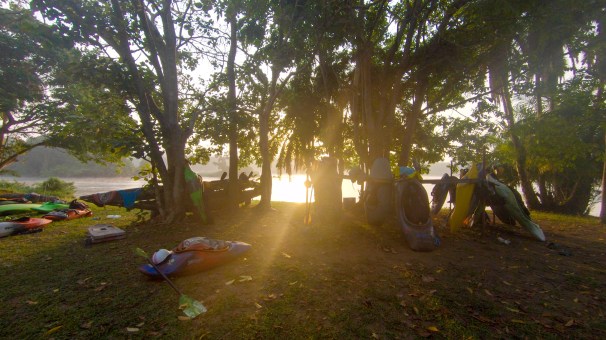
Kayaks stacked at sunrise on the Hairy Lemon island
If you think you’ll stay sober, think again
The Nile Explorers Bar is legendary when it comes to the rowdy shenanigans that have gone on there. Everything from motorcycles being ridden through it, to Evan Garcia famously putting a hole in his foot curtailing his ability to take part in Steve Fisher’s Congo mission.

Jinx, the feral dog that took up residence at the Explorers Camp many years ago.
Apparently it has calmed down a lot these days since the Bujagali dam went live and taking away some of the biggest rapids on the river. What wasn’t counted on during our trip was the arrival of the guys taking part in Unleashed. All I’ll say is that I got rather drunk and somebody was spotted fixing the bench in the morning that I was apparently dancing on… Let’s put this into perspective. I’m not usually “Mr Party Guy”. So there must be something in the air.
It was during this madness that Dane Jackson gave me some incredibly useful advice. That being that I should give the Dead Dutchman rapid a go because one way or the other I’ll get to the bottom of it. I’m not sure what to make of that…

Making our way over to the Hairy Lemon island
You will ride a bike without a helmet
Think you’ll go to Uganda without going on a Boda bike with no helmet? Think again. It’s one of the mains methods of travel, and while you will wonder what the hell you are doing the first time you go through the middle of a bustling town like Jinja on one, by the end of the trip you’ll think it’s perfectly normal. In fact by the end of the trip you’ll just accept mind bendingly atrocious driving by other people on the road as perfectly acceptable and normal. Luckily our drivers were excellent and kept us safe!
One thing to note if you do go one one of these bikes. The majority of roads between villages in Uganda are just dirt tracks. You will get absolutely covered in dust, and you can’t avoid it. The stuff gets everywhere. Sunglasses are a must, although when you take them off afterwards you will look ridiculous. It’s normal.
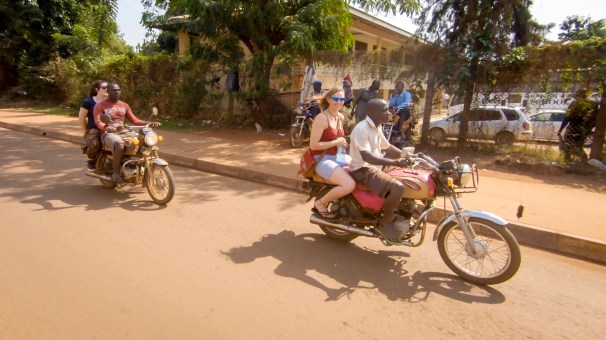
Boda boda! You will go on one of these!
Things we learned
- That a family saloon car can do everything a Land Rover can. Sometimes better.
- You will get covered head to toe in red colour dust. Every day, without fail.
- You get even more covered head to toe in red coloured dust on the Boda bikes.
- That even after a week of drinking your bar bill will be the same as that of one round of drinks in the UK.
- Praying Mantis’s are cool.
- Roof racks are for pussies.
- Riding on the back of a motorbike without a helmet is normal.
- Mosquito repellant clothing is worth every penny even if you end up looking like Ray Mears.
- Go on a fitness regime before going again!
- Catching the eddy just above Itanda Falls is the only time I’ve been genuinely scared eddying out from a grade 2 rapid!
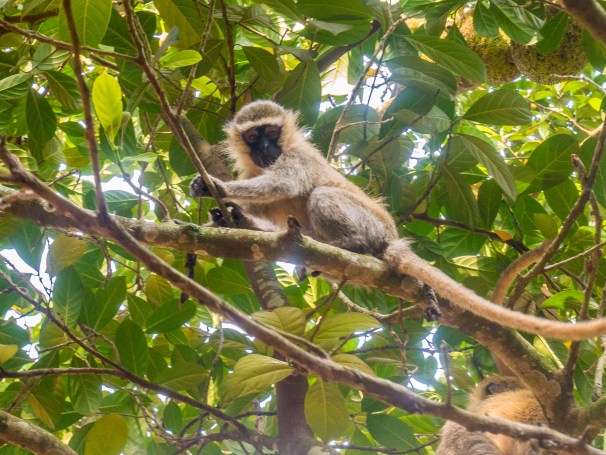
An amazing country
Uganda is an amazing place. The sound of the wildlife, which is around you at all times, is incredible. Monkey’s come to watch you paddling past, Eagles and Kites soar above you, otters and fishing birds surface around your boat. It is a place like no other, and the UK seems so lifeless and colourless by comparison. We’d love to go back and see more of the country as well as do some more boating. In fact I cannot remember being so depressed at having to leave a place. I just hope that the village of Bujagali and the surrounding area can maintain some continuity of paddling tourism after the new dam goes online.
There’s so much that I could say of the place and the culture that would simply take too long in this already epic long blog entry. Suffice to say that there’s no place like it.
I made a video of our trip below.
 The Kayaking Journal
Recent comments